Francisco Benitez - Artist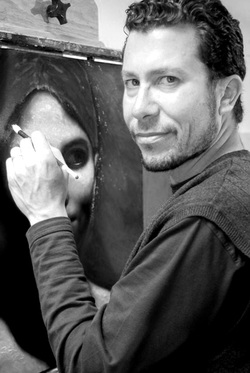
I am a Santa Fe-based artist of Latino background who has developed a career exhibiting both in the US and Europe. Being exposed to theater as a child (my parents had a very successful flamenco dance troupe) and to the sensibilities of my Spanish father, I began painting emulating the great Spanish masters such as Goya and Velázquez. I later discovered Caravaggio and the work his followers--my first body of paintings had distinct tenebrist sensibilities, which highlighted the luminosity of the flesh and psychology of the characters in theater-like settings.
I then became fascinated with the Fayum portraits, and for a number of years did a great deal of research on the ancient methods of the Greek and Egyptian painters. I learned how to use the heated wax technique of encaustic to paint portraits. I then created various bodies of work centered on contemporary portraits of people using an ancient method and approach. I lately developed a project called, “Doña Inés Lost Her Slipper”, which was inspired my own family history of growing up in a multi-ethnic household of Europeans and Native Americans. It is a project centered on the fictional story of a Spanish aristocrat who travels to the New World and is presented with a Native American maidservant. I ran a successful kickstarter campaign for it, and it was exhibited at Santa Fe’s premier space for alternative art projects—the Santa Fe Community College Visual Arts Gallery, with much press interest. It then traveled during the summer of 2015 to the Palazzo Nicolaci in Noto, Sicily. A catalog was produced in conjunction with the show. The main themes in my work are a focus on the recuperation of Old Master techniques and approaches, with a heightened awareness of contemporary art. I enjoy juxtaposing art styles from various periods to highlight the political contexts, gender roles, and psychological realities of the various human subjects I paint. I use historical pigments and materials to excavate the past, and make statements about our own place in history at this time of upheaval and inexorable change. |
On the Web 


|
Upcoming Exhibitions and Press
Recent and Upcoming:
One-Person exhibition at the Galerie de la Cascade, Salles-la-Source, France, September 2024
"Ekfrasi", a two-person exhibition, featuring Francisco Benitez and Michael Bergt, to take place at Gallery Koart, Catania, Italy, Sept-Oct 2024. Curated by Aurelia Nicolosi, director of Gallery Koart, on the theme of the "Imagines" by Philostratos.
"Ecoute la forêt plutôt que l'arbre qui tombe", an exhibition curated by Jean-Luc Fau, at the Galerie de la Cascade in Salles-la-Source, France, opening May13, 2023. The exhibition lasts until June 18 and is inspired by the idea of forests and woods. It brings together a number of artists from Southwestern France, Paris, and beyond.
Galerie de la Cascade
Hampstead Affordable Art Fair, London, UK
May 11-14, 2023
NOONPOWELL FINE ART
LONDON
Harvard Art Museum encaustic workshops
March and November, 2022
Press:
Dallas Art Beat, April 2021, by Cristee Cook
Avanti Tutta Sicilia (Italian and English), April 2021, by Davide Gianmaria Arico'
Site en français
franciscobenitez.fr
Sito in italiano
franciscobenitez.net
One-Person exhibition at the Galerie de la Cascade, Salles-la-Source, France, September 2024
"Ekfrasi", a two-person exhibition, featuring Francisco Benitez and Michael Bergt, to take place at Gallery Koart, Catania, Italy, Sept-Oct 2024. Curated by Aurelia Nicolosi, director of Gallery Koart, on the theme of the "Imagines" by Philostratos.
"Ecoute la forêt plutôt que l'arbre qui tombe", an exhibition curated by Jean-Luc Fau, at the Galerie de la Cascade in Salles-la-Source, France, opening May13, 2023. The exhibition lasts until June 18 and is inspired by the idea of forests and woods. It brings together a number of artists from Southwestern France, Paris, and beyond.
Galerie de la Cascade
Hampstead Affordable Art Fair, London, UK
May 11-14, 2023
NOONPOWELL FINE ART
LONDON
Harvard Art Museum encaustic workshops
March and November, 2022
Press:
Dallas Art Beat, April 2021, by Cristee Cook
Avanti Tutta Sicilia (Italian and English), April 2021, by Davide Gianmaria Arico'
Site en français
franciscobenitez.fr
Sito in italiano
franciscobenitez.net
